ENTRY VECTOR
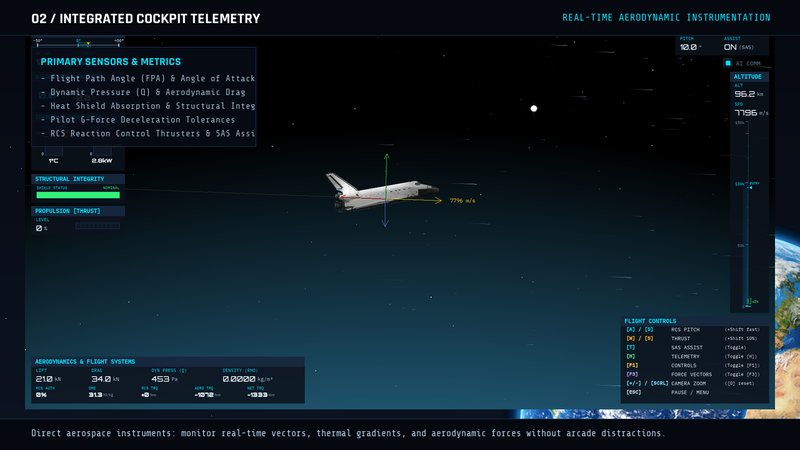
Entry Vector is a hardcore 2D aerospace survival simulator focused purely on the most dangerous and chaotic phase of spaceflight: Atmospheric Reentry. You do not dogfight enemy ships or glide onto a runway. Dropped into the hypersonic corridor at Mach 25 (over 7,800 m/s), your mission is to wrestle with blistering shockwave temperatures exceeding 2,000°C, crushing deceleration G-forces, and extreme dynamic pressure (Q). Your only lifeline is the Reaction Control System (RCS).
About This Game
ENTRY VECTOR — Hypersonic Reentry Simulator
"The objective of reentry is not to land. It is to exit the critical atmospheric phase in conditions that allow the mission to continue safely."
— Athanode Aerospace Flight Directive 01
⚡ What is Entry Vector?
Entry Vector is a hardcore 2D aerospace survival simulator focused purely on the most dangerous and chaotic phase of spaceflight: Atmospheric Reentry.
You do not dogfight enemy ships or glide onto a runway. Dropped into the hypersonic corridor at Mach 25 (over 7,800 m/s), your mission is to wrestle with blistering shockwave temperatures exceeding 2,000°C, crushing deceleration G-forces, and extreme dynamic pressure (Q).
Your only lifeline is the Reaction Control System (RCS), fine-tuned propulsion, and an uncompromising mastery of aerodynamic lift and drag. Reach the terminal checkpoint at 5,000 meters with your spacecraft's structure and pilot intact.
🔬 Core Simulation Physics
- 🔥 Thermal Absorption & Progressive Degradation: Compression heating spikes past 1,500°C in the mesosphere. Beyond 2,000°C, the ablative shield begins to degrade. Sustained extreme heat steadily strips structural integrity, giving you a critical window to bleed energy or pull out before catastrophic breakup.
- 🌪️ Exponential Atmospheric Density & Drag: Air isn't a solid barrier; it thickens exponentially as altitude drops. Exposing your heat shield high in the thin air bleeds vital speed without destructive thermal shock. Entering too steep into dense lower layers results in instant structural incineration.
- ⚖️ Angle of Attack (AoA) & Lift/Drag Balance: Use your RCS thrusters to pitch the spacecraft. "Surf" the upper atmosphere with positive lift to extend your glide corridor, or slice through the air with a lower AoA to alleviate unbearable pilot G-loads.
- 💥 Atmospheric Skip vs. Ballistic Plunge: Come in too shallow with excessive lift, and your ship will ricochet off the dense atmosphere back into the freezing vacuum of space. Come in too steep, and deceleration forces will crush your vehicle. Finding the narrow entry corridor is the true test of an astronaut.
- 📊 Trauma-Based Mission Evaluation: Reaching 5,000m is only half the battle. Your mission rating is scored by your cumulative trauma telemetry: Peak G-loads, Peak Shield Temperature, and preserved Structural Integrity.
More from Helder A. Gabriel

The Journey of Making This Game
A ideia do jogo surgiu ao assistir alguns vídeos de lançamentos de foguetes e reentradas orbitais de ônibus espaciais. Quais seriam as forças e física envolvidas? Seria possível simplificar e simular isso tudo? O desafio então foi conseguir agregar um núcleo de física simplificada, e mesmo com o auxílio de IA para pesquisar fórmulas diversas, ainda tivemos um grande trabalho para simplificar e tornar "jogável" sem distorcer a física real envolvida.
How Uniday Studio Helped
Os cursos e materiais oferecidos foram muito importantes, e principalmente o apoio e o incentivo do "primeiro jogo publicado". Sim, apesar de tudo que você estuda e pode até já possuir de conhecimento, o marco do "primeiro jogo" é um divisor de águas. Não é a mudança de vida, nem do dia-a-dia, mas sim a "virada de chave" que o faz perceber que apesar de ser um mundo enorme o desenvolvimento de jogos, você pode caminhar nele.

Create Games with Python!
Script everything in Python, but with the speed of C++. Easy, intuitive, and powerful.
Learn More
Comments
No comments yet
Be the first to share your thoughts!