What is Cave Engine? A Complete Overview for Indie Developers
If you're building a 3D desktop game as an indie developer, you probably asked the same question many others ask: what is Cave Engine and how does it compare to Unity, Unreal, or Godot?
Cave Engine is a C++ game engine designed specifically for fast indie game development, with Python scripting for gameplay logic. The goal is simple: reduce friction between opening the engine and actually building your game. The engine removes unnecessary complexity and focuses on iteration speed, lightweight builds, and a straightforward workflow.
In practice, Cave lets you prototype quickly, build full games with modern rendering and physics, and ship commercial projects without paying royalties.
“A game dev tool is like a joke. If you need to explain it, then it's not that good.” — Cave Engine design philosophy
This article gives you a complete overview of what Cave Engine is, how it works, and why many indie developers see it as a strong alternative to larger engines.
Why Cave Engine Exists

Many modern engines target extremely different audiences.
Some tools aim at AAA production pipelines, while others prioritize simplicity but lack production-ready systems. Indie developers often end up dealing with tools that require long setup time before real gameplay development begins.
Cave Engine was created to fill that gap.
The engine focuses on small teams and solo developers who want to build complete 3D games quickly. Instead of requiring extensive configuration or complex pipelines, Cave provides most systems already integrated into the editor and ready to use.
When developers open engines like Unity, Unreal, or Godot, they often spend hours configuring rendering pipelines, dependencies, or project settings before building gameplay. Cave removes most of that setup so developers can start building immediately.
Designed Around Real Production
Cave Engine is developed and actively used by the same studio that builds it. Features are first created and tested internally in real game projects before being released publicly.
This workflow ensures that the systems shipped in the engine are already used in production environments rather than experimental features.
Core Architecture of Cave Engine
Cave follows a modern entity-component architecture, which is a common structure in game engines. Instead of writing complex inheritance trees, developers build gameplay by attaching components to entities.
Entity and Component System
Every scene in Cave contains entities. An entity becomes functional by attaching components such as:
- Transform components for position and rotation
- Mesh components for rendering
- Physics components for simulation
- Python components for gameplay logic
- UI components for interface elements
This architecture keeps gameplay modular and reusable.
Entity Templates (Reusable Game Objects)
Cave uses Entity Templates, which function similarly to prefabs in other engines. A template defines a reusable hierarchy of entities and components.
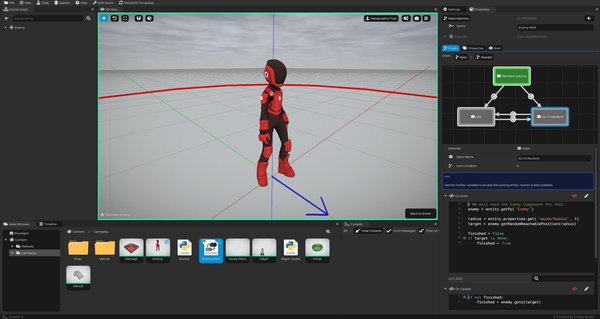
Developers can instantiate the template multiple times across scenes while maintaining a shared structure. If the base template changes, all instances update accordingly.
Templates are commonly used to create:
- enemies
- vehicles
- weapons
- environmental props
- reusable gameplay systems
This system helps teams maintain clean and reusable project structures.
Python Gameplay Scripting with a C++ Core
One of the defining features of Cave Engine is its dual-language design.
The engine itself is written in C++ for performance, while gameplay logic is written in Python for simplicity.
Why this matters
C++ handles the heavy systems:
- rendering
- physics
- animation
- asset management
- engine internals
Python handles gameplay behavior.
Because most Python code simply calls optimized C++ engine functions, developers get the benefit of fast runtime performance with easy scripting.
Example Python component:
import cave

class MyComponent(cave.Component):

    def start(self, scene: cave.Scene):
        pass

    def update(self):
        events = cave.getEvents()

    def end(self, scene: cave.Scene):
        pass
This approach allows beginners and experienced developers alike to iterate rapidly without long compile cycles.
Major Engine Features
Cave Engine includes most systems required to build a full 3D game.
Integrated Game Editor
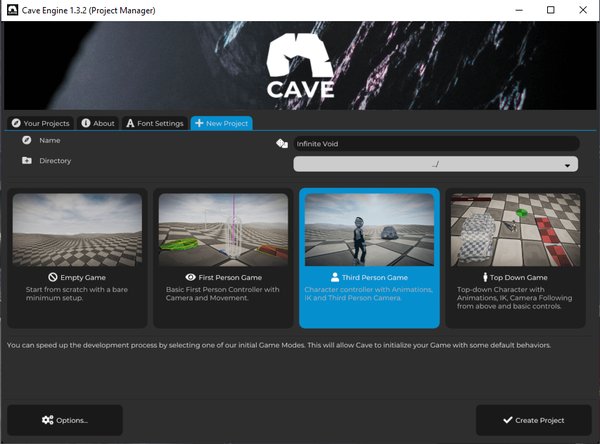
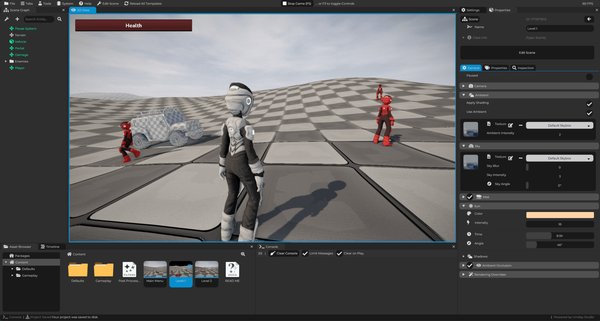
The editor allows developers to create scenes, import assets, write scripts, and build gameplay without leaving the engine.
The interface focuses on speed and minimal loading times.
Developers rarely encounter shader compilation or asset preparation delays during normal workflows.
Modern Rendering Pipeline
Cave includes a modern physically based rendering pipeline with features such as:
- PBR materials
- cascaded shadow maps
- depth pre-pass optimization
- mesh instancing
- frustum culling
- batching systems
These systems help maintain good performance even in complex scenes.
Built-In Physics
The engine integrates Bullet Physics, which enables:
- rigid body simulation
- character controllers
- vehicle physics
- ragdoll systems
- constraints and joints
Physics can be combined with Python scripts to create gameplay interactions.
Animation System
Cave includes a skeletal animation system capable of:
- layered animation blending
- bone filtering
- animation callbacks
- root motion extraction
Developers can combine multiple animations at once, such as walking while reloading a weapon.
Terrain and Environment Tools
The terrain system allows developers to create large worlds using heightmaps. Tools include:
- sculpt brushes
- erosion tools
- terrain painting
- path alignment tools
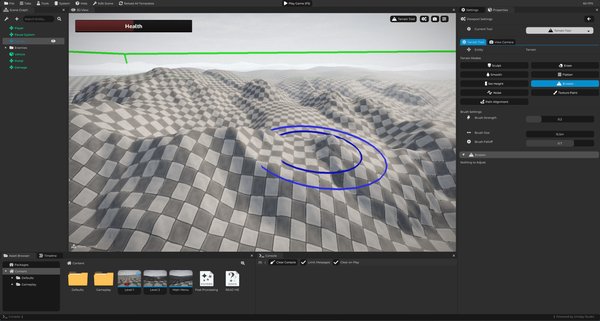
Terrain can be several kilometers wide while maintaining optimized rendering.
Workflow Advantages for Indie Developers
Cave Engine was designed with a specific goal: maximize development speed for small teams.
Instant Iteration
The engine minimizes visible compile steps. Developers will NOT see:
- shader compilation
- code compilation delays
- asset cooking steps
This allows gameplay iteration to happen almost immediately after changes.
Lightweight Projects
Games built with Cave often produce very small executables. Simple projects can be as small as 10–20 MB, which is significantly smaller than many other engines.
The editor itself also uses very little memory compared to larger engines.
Built-In Systems Reduce Tooling
Cave includes many production systems by default:
- particle systems
- timeline cutscenes
- hierarchical state machines for AI
- UI creation tools
- profiling tools
Developers spend less time integrating third-party tools.
Who Should Use Cave Engine
Cave Engine is ideal for developers who want to build 3D desktop games quickly without large engine overhead.
It works particularly well for:
- solo developers
- indie studios (5–15 people)
- programmers who prefer scripting languages
- developers building PC-focused games
Because the engine emphasizes rapid iteration and built-in systems, it can significantly reduce development time for small teams.
FAQ
Is Cave Engine free?
No. Cave Engine is a paid engine, but it has no royalties on shipped games. Developers purchase the engine and keep all game revenue.
What programming language does Cave Engine use?
The engine core is written in C++, while gameplay logic is written in Python.
Can you build commercial games with Cave?
Yes. Cave is designed for commercial projects and does not require revenue sharing.
What platforms does Cave support?
The engine currently focuses on desktop game development.
Is Cave good for beginners?
Yes. Python scripting makes it approachable for beginners while still allowing advanced developers to build complex systems.
Final Thoughts
Cave Engine sits in a unique position in the game development ecosystem.
Large engines like Unreal provide massive AAA production pipelines, while simpler engines may lack integrated systems required for production games. Cave focuses on a different goal: fast development for indie teams building desktop 3D games.
By combining a high-performance C++ core with Python scripting, the engine enables developers to build complex games without heavy development overhead.
For many indie developers, that balance between power, simplicity, and iteration speed is exactly what makes Cave Engine worth exploring.