Python continues to grow among developers. The 2025 Stack Overflow Developer Survey ranked Python among the three most widely used programming languages worldwide. Many programmers prefer Python because it is readable, fast to prototype with, and excellent for building gameplay logic.
That creates a clear demand: game engines that support real Python scripting. Many engines claim Python support but rely on plugins or languages that only resemble Python. This article focuses only on engines that natively support Python scripting.
If you already know Python and want to build games without switching to C# or C++, these are the four best Python game engines in 2026.
1. Cave Engine — The Best Python Game Engine for Indie Developers
Cave Engine is a modern 3D game engine built with a hybrid architecture. The core engine is written in C++ for performance, while gameplay logic is written entirely in Python.
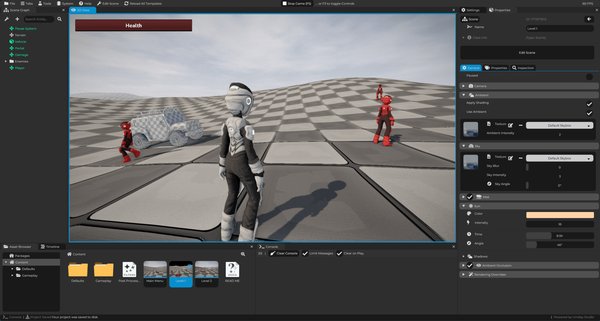
The engine exposes a Python API where gameplay behavior is implemented through components attached to entities, while heavy systems like rendering, physics, and animation run in optimized C++.
The result is a workflow where developers write simple Python code while the engine handles the heavy lifting.
Why Python developers choose Cave
Cave was designed for rapid iteration. Scripts run immediately and the engine avoids slow compilation steps that are common in many other engines.
This makes the development workflow feel very natural for Python developers who are used to quick scripting cycles.
Key features
- Native Python scripting API
- High-performance C++ backend
- Entity-component architecture
- Integrated editor and Python tooling
- Built-in physics using Bullet
- PBR rendering pipeline
- Terrain tools and particle system
- Timeline system for cutscenes and events
Example Python gameplay component
import cave

class PlayerController(cave.Component):
    def start(self, scene):
        # Getting the Character Component:
        self.character = self.entity.get("Character Component")

    def update(self):
        events = cave.getEvents()

        # Making the character jump with Space Key:
        if events.pressed(cave.event.KEY_SPACE):
            self.character.jump()
Python controls gameplay behavior while optimized engine systems run underneath.
Game AI expert Ian Millington summarized the benefit of this approach:
“Python is extremely effective for gameplay scripting because it enables rapid experimentation.”
For developers who want a modern engine centered around Python, Cave currently offers one of the most complete ecosystems available.
2. UPBGE — The Blender-Based Python Game Engine
UPBGE (Uchronia Project Blender Game Engine) is the continuation of the original Blender Game Engine that was removed from Blender in 2019.
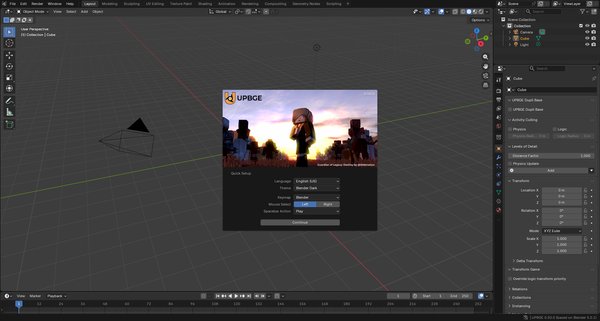
The project modernizes the engine while keeping the same Python scripting system and Blender integration.
Why developers choose UPBGE
UPBGE allows developers to create games directly inside Blender. Artists and designers already familiar with Blender can create models, animations, and gameplay logic in the same environment.
Python scripts can control objects, physics, events, and gameplay behavior.
Key features
- Native Python scripting
- Fully integrated with Blender
- Visual logic nodes combined with Python scripts
- Good physics system
- Ideal for artist-driven workflows
UPBGE works especially well for small to medium games and developers who already rely heavily on Blender.
There are two main branches for UPBGE: The latest, based in the current Blender, and the 0.2.5, still based off Blender 2.79. Some developers prefer the old school version:
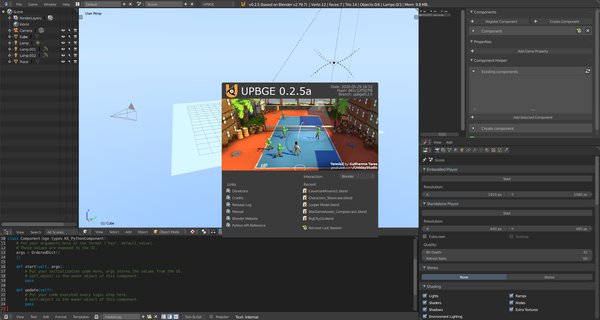
But both have many advantages.
3. Panda3D — A Mature Python Game Engine
Panda3D is one of the most established Python game engines still used today. Originally developed by Disney and Carnegie Mellon University, it remains a powerful open-source platform.

Developers can write most gameplay logic directly in Python while the engine core runs in C++.
Why developers use Panda3D
Panda3D provides a flexible architecture that gives programmers deep control over rendering, input, and game systems.
Many research projects, simulations, and indie games still rely on Panda3D.
Key features
- Python scripting API
- Powerful rendering capabilities
- Cross-platform deployment
- Mature documentation
- Large open-source ecosystem
However, Panda3D does not provide a fully modern visual editor, so most development happens through code.
4. Ursina Engine — Python Engine for Rapid Prototyping
Ursina is a lightweight Python game engine built on top of Panda3D. Its main goal is simplicity and fast development.
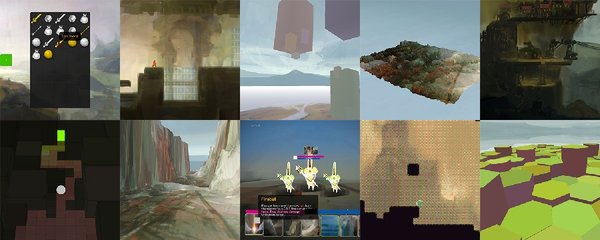
The engine provides a very clean API that allows developers to create games with minimal Python code.
Why developers use Ursina
Ursina is ideal for rapid prototyping, small indie games, or learning game development with Python.
Example Ursina script
from ursina import *

app = Ursina()

player = Entity(model='cube', color=color.orange)

def update():
    player.x += held_keys['d'] * time.dt * 5
    player.x -= held_keys['a'] * time.dt * 5

app.run()
Key features
- Pure Python scripting
- Extremely simple API
- Fast prototyping workflow
- Built on top of Panda3D
Ursina is excellent for experiments and small projects, though it lacks some production-level systems found in larger engines.
Python Game Engines Comparison
| Engine | Python Support | Best Use Case |
|---|---|---|
| Cave Engine | Native | Indie 3D game development |
| UPBGE | Native | Blender-based development |
| Panda3D | Native | Programmers and research |
| Ursina | Native | Prototypes and small games |
For developers who want Python as the primary scripting language, these four engines represent the most relevant options in 2026.
Among them, Cave stands out as a modern engine with a full editor and production-ready tools built around Python scripting. If you want, you can read more about Cave by clicking here.
Why Python Game Development Is Growing
Several trends explain why Python continues to gain traction in game development:
Faster iteration
Python allows developers to test gameplay ideas quickly without compilation.
Easier learning curve
New developers often learn Python before languages like C++ or C#.
AI and procedural generation
Many modern tools for AI, data processing, and procedural generation are built around Python.
According to GPU industry analyst Jon Peddie:
“Python continues to expand across technical fields because of its simplicity and ecosystem.”
These trends make Python an attractive language for indie developers.
FAQ — Python Game Engines
What is the best Python game engine for 3D games?
Cave Engine is currently one of the strongest options because it combines Python scripting with a high-performance C++ backend and a full game editor.
Is Panda3D still used today?
Yes. Panda3D remains popular for simulations, research, and indie games.
Is Python fast enough for games?
Yes. Most Python engines run heavy systems in C++ while Python handles gameplay logic.
Is UPBGE good for indie games?
Yes. It works especially well if your workflow already relies on Blender.
Is Ursina good for beginners?
Yes. Ursina is one of the easiest Python game engines to learn.
Final Thoughts
Python is becoming increasingly common in game development. Developers want faster iteration and simpler scripting workflows. Several engines support this approach today, but only a few treat Python as a first-class scripting language.
Among them, Cave Engine offers one of the most balanced solutions: a modern 3D engine with a fast C++ core and a Python scripting layer designed for rapid development.
For developers who prefer Python and want to build complete games without switching languages, these engines represent the best starting points in 2026.