Many developers who used the Blender Game Engine (BGE) still want the same workflow today: build assets in Blender, write simple Python scripts, and iterate quickly without dealing with massive AAA pipelines.
When BGE was removed from Blender in 2019, the community fragmented. Some developers moved to Unity or Godot. Others stayed with forks like UPBGE, which continues the original concept. But by 2026, many developers are still searching for something that feels like the original BGE philosophy.
That’s where Cave Engine enters the conversation.
Cave is a modern 3D desktop game engine written in C++ and scripted entirely in Python. It was built to provide the same fast iteration workflow that BGE users loved, but with a modern architecture, optimized rendering pipeline, and a complete standalone engine environment.
If you were a Blender Game Engine developer, you will recognize many familiar concepts.
Why Blender Game Engine Developers Still Look for Alternatives
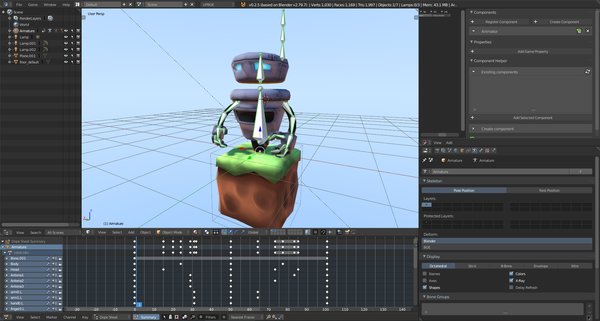
Blender Game Engine had a unique philosophy. It focused on fast iteration and simplicity, not massive production pipelines.
You could:
- Model in Blender
- Attach logic quickly
- Run the game instantly
- Iterate without compilation
That workflow attracted thousands of indie developers.
However, BGE had limitations:
- It was tied to Blender’s interface
- Rendering technology stagnated
- Physics and animation systems were limited
- Development stopped when it was removed from Blender
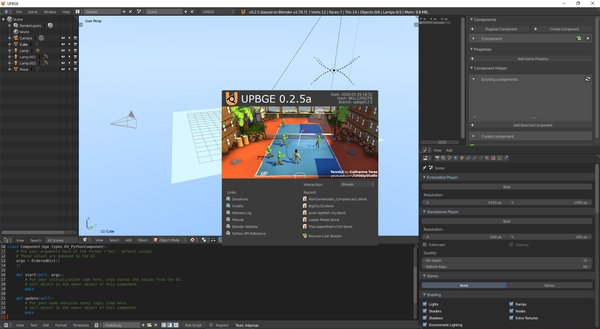
The community responded with UPBGE, which remains the most popular BGE continuation today. UPBGE improved many aspects of BGE, but it still inherits some structural limitations from the original engine architecture.
Many developers eventually reach a point where they want:
- Modern rendering pipelines
- Better large-project architecture
- A standalone game engine environment
- Faster performance
That’s where engines like Cave start to make sense.
What Cave Engine Is (and Why It Feels Familiar)
Cave Engine is a modern standalone 3D engine designed for desktop games. It was written in C++ for performance and exposes the gameplay layer entirely through Python scripting.
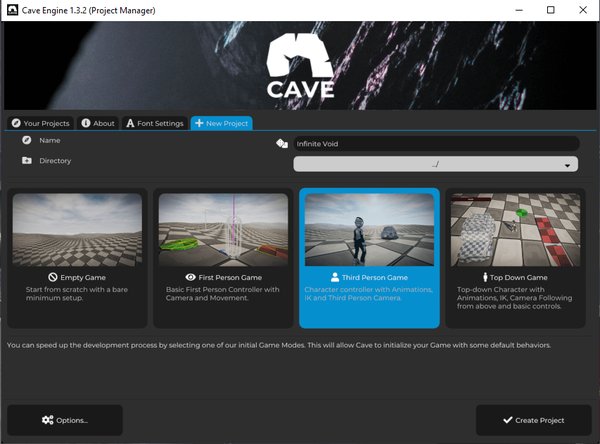
This combination is immediately attractive to Blender Game Engine developers.
Why?
Because BGE users were already used to Python-based game logic.
With Cave, you keep that simplicity but gain a much more advanced engine architecture.
Key characteristics include:
- C++ core engine with Python scripting
- Physically-based rendering pipeline
- Integrated editor for scenes and assets
- Bullet physics integration
- Animation layering and skeletal systems
- Built-in terrain tools and particle systems
- Timeline tools for gameplay events and cutscenes
Cave was designed specifically for fast iteration and minimal friction, something many BGE users deeply value.
Cave vs Blender Game Engine and UPBGE
The Philosophy Is Similar
Blender Game Engine focused on fast iteration. Cave was built with the same goal.
You open the engine and immediately start building your game.
There are no visible shader compilation steps, asset cooking pipelines, or long reload times interrupting development. This workflow feels much closer to BGE than to engines like Unreal or Unity.
The Architecture Is Much More Modern
The biggest difference between Cave and BGE/UPBGE is the internal architecture.
Cave uses a modern entity-component system.
| Blender Game Engine / UPBGE | Cave Engine |
|---|---|
| Objects | Entities |
| Logic bricks / scripts | Python components |
| Groups | Entity templates |
| Blender scene | Engine scene |
This structure scales better for larger projects.
BGE was excellent for prototypes and small games, but complex projects often became difficult to maintain. Cave was designed to handle larger projects without sacrificing simplicity.
Python Scripting Feels Natural for BGE Users
BGE developers typically wrote logic in Python. That experience transfers directly.
A basic gameplay component in Cave looks like this:
import cave

class PlayerController(cave.Component):
    def start(self, scene):
        pass

    def update(self):
        events = cave.getEvents()

    def end(self, scene):
        pass
If you already wrote scripts in BGE or UPBGE, the learning curve is extremely small. Python remains the high-level orchestration language while the heavy work happens inside optimized C++ systems.
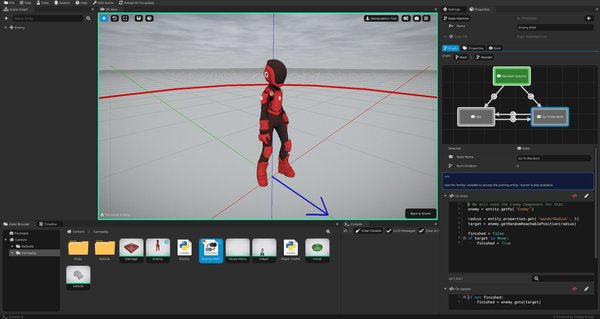
Not only that, but you also get the benefit of the many new and modern system that Cave offers to you to extend your Python Logic. For example, have have a complete State Machine System that is scriptable in Python and allow you to create advanced character AI:
Why Many UPBGE Developers Eventually Look Beyond Blender
UPBGE is still a great project and remains a strong continuation of BGE. But there are structural realities, since UPBGE is still tied to Blender’s ecosystem, which means:
- The interface is primarily designed for 3D modeling
- The engine is not a dedicated game development environment
- Some workflows mix DCC tasks and game engine tasks
Cave separates these concerns.
Blender becomes your content creation tool, while Cave becomes your game development environment.
This separation often leads to a more scalable workflow.
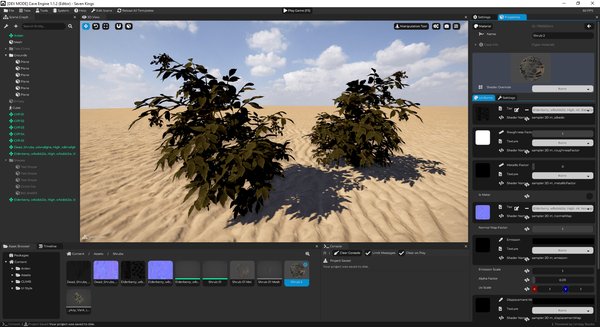
Typical pipeline:
- Create models and animations in Blender
- Export via FBX, OBJ, or Collada
- Import into Cave
- Build gameplay using Python scripts
The engine integrates asset import workflows through tools like Assimp to support common formats.
Performance Differences Compared to BGE
Another major advantage is performance architecture. Cave’s engine core is entirely written in C++, while Python handles only the high-level gameplay logic.
This means:
- Rendering systems run natively
- Physics runs in Bullet
- Animation systems run in optimized C++ code
- Python scripts mostly orchestrate gameplay
This hybrid architecture gives developers both:
- fast iteration
- native performance
That combination is difficult to achieve in engines built primarily around scripting layers.
They both use the same Physics Engine
Cave Engine, just like BGE, uses Bullet Physics behind the scenes to handle all Physics of your game. So you will find a lot of similarities in this part. A good observation is that Cave's implementation of this library is more modern and this means that it integrates better and have less issues.
A Workflow That Feels Close to BGE
For developers who loved BGE, the Cave workflow feels surprisingly familiar.
Typical development cycle:
- Create assets in Blender
- Import assets into Cave
- Place entities in the scene
- Attach Python components
- Press play and iterate instantly
There is very little friction between idea and playable result.
That’s exactly the experience many developers originally loved about Blender Game Engine.
Is Cave the Best Blender Game Engine Alternative?
If you want a direct continuation of BGE inside Blender, then UPBGE is still the closest option.
But if you want the same philosophy with a modern standalone engine, Cave is one of the most interesting alternatives available in 2026.
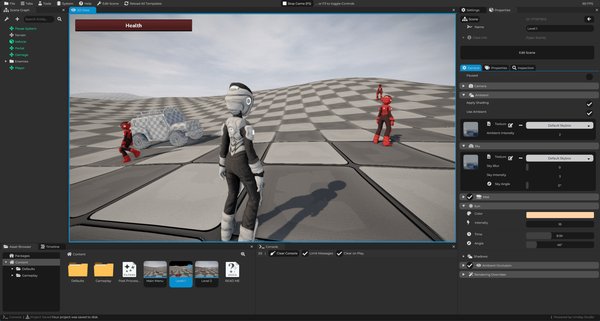
It keeps the core ideas that BGE developers valued:
- Python scripting
- Fast iteration
- Simple architecture
- Indie-focused workflow
At the same time it adds modern capabilities:
- advanced rendering pipelines
- animation systems
- physics integration
- production-ready engine architecture
For many developers who started with BGE, Cave feels like the next step rather than a completely different ecosystem.
Final Thoughts
The Blender Game Engine left a lasting impact on indie development.
Even years later, developers still want engines that prioritize speed, simplicity, and creative iteration.
UPBGE keeps the original spirit alive inside Blender.
Cave takes that philosophy further by building a dedicated engine around it.
If you loved developing games with BGE, you will probably feel comfortable inside Cave very quickly.
And that’s exactly the point.
FAQ
Is Blender Game Engine still available in 2026?
The original Blender Game Engine was removed from Blender after version 2.79. The community fork UPBGE continues development and remains the main continuation of BGE.
Is Cave similar to Blender Game Engine?
Yes. Both engines emphasize fast iteration and Python scripting. The main difference is that Cave is a standalone engine with a modern architecture and rendering pipeline.
Can Blender assets be used in Cave?
Yes. Cave supports importing common formats such as FBX, OBJ, and Collada, making it easy to export assets from Blender and use them directly in your game.
Is Python fast enough for game development?
In Cave, Python is used mainly for gameplay logic while performance-critical systems run in C++. This allows fast iteration without sacrificing performance.
Is Cave good for indie developers?
Yes. Cave was designed specifically for indie developers and small teams who want a fast workflow without the complexity of large AAA engines.