Indie developers constantly face a difficult choice when picking a game engine. The decision often comes down to tools like Unreal Engine and newer alternatives like Cave Engine. Both can create professional 3D games, but they target very different workflows and development styles.
Unreal is a massive AAA production environment used by some of the biggest studios in the world. Cave Engine was built specifically to help indie developers move faster with fewer barriers. If you're building games solo or with a small team, the differences become very clear.
This comparison explains which engine fits indie developers better in 2026 and why.
Cave Engine vs Unreal Engine at a Glance
| Feature | Cave Engine | Unreal Engine |
|---|---|---|
| Primary scripting | Python | C++ and Blueprints |
| Engine size | Lightweight (Less than 20MB) | Very large (Multiple GB) |
| Startup time | Instant | Heavy loading |
| Compilation | No visible compile steps | Frequent shader and C++ compilation |
| Target users | Indie devs and small teams | AAA studios and large teams |
| Pricing | One-time purchase | Royalty-based (5% after $1M revenue) |
| Iteration speed | Extremely fast | Slower due to build steps |
For many indie developers, the biggest difference is iteration speed. The faster you can test gameplay ideas, the faster your game improves.
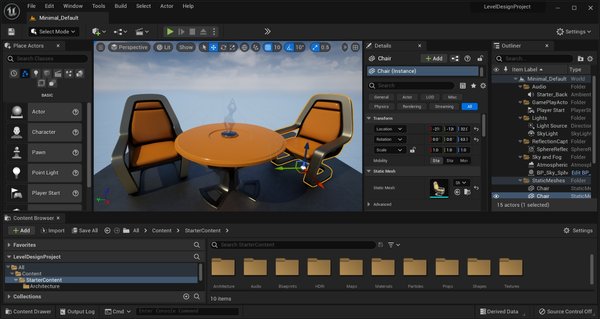
Unreal Engine: A Powerful AAA Tool
Unreal Engine is one of the most advanced real-time engines available. It powers games like Fortnite and hundreds of AAA productions.
The engine includes technologies such as:
- Nanite virtualized geometry
- Lumen global illumination
- Massive world streaming
- Blueprint visual scripting
- Advanced cinematic tools
These features allow studios to build extremely complex projects.
However, the same power also introduces complexity.
The Cost of Power
Unreal projects often involve:
- long shader compilation times
- C++ build pipelines
- heavy project sizes
- complex editor systems
For large studios with dedicated engineers, this is manageable. For indie developers working alone or in small teams, it can slow development significantly.
Tim Sweeney, CEO of Epic Games, once described Unreal as:
“A complete ecosystem for building high-end interactive experiences.”
That ecosystem is powerful. But it also comes with a steep learning curve.
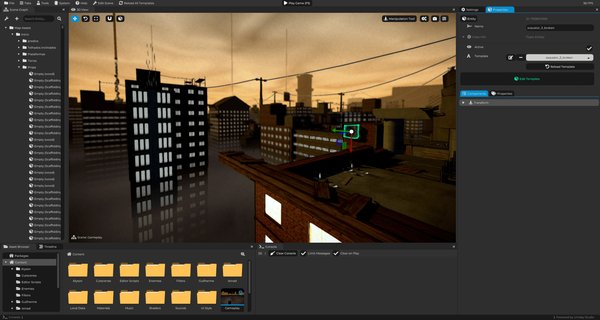
Cave Engine: Built for Fast Indie Development
Cave Engine was designed with a completely different philosophy: remove friction from game development. Instead of focusing on AAA production pipelines, Cave focuses on speed, simplicity, and small-team productivity.
The engine is written entirely in C++ but allows developers to write game logic in Python. This means heavy systems run in optimized native code while scripting remains easy to write and iterate.
According to the engine documentation, Cave was created to be:
“fast, lightweight, simple and easy to use”
That philosophy influences every part of the engine.
What Makes Cave Faster for Indies
Cave removes several common bottlenecks found in larger engines:
- no visible shader compilation
- no code compilation during gameplay iteration
- lightweight editor startup
- small exported game sizes (often 10–20 MB)
This allows developers to prototype gameplay ideas almost instantly. For indie developers who iterate dozens of times per day, this speed matters more than advanced cinematic features.
Development Workflow Differences
Unreal Workflow
A typical Unreal development loop looks like this:
- Modify Blueprint or C++ code
- Compile the project
- Wait for shader compilation
- Launch the editor again
- Test gameplay
This workflow works well for structured teams but can slow rapid experimentation.
Blueprint Visual Scripting
Unreal’s Blueprint system allows non-programmers to build gameplay using node graphs. While powerful, large Blueprint graphs can become complex and difficult to maintain in big projects.
Cave Workflow
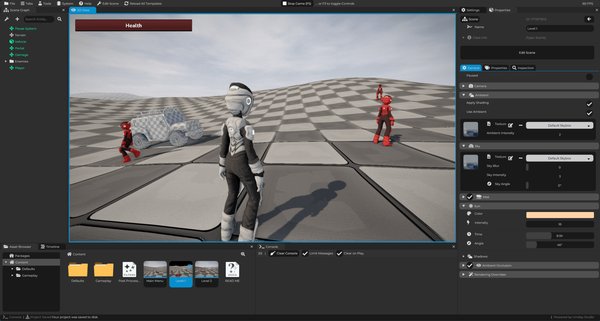
Cave uses a much simpler development loop:
- Write Python logic
- Press play
- See results immediately
There are no visible compile steps during iteration. Gameplay scripts simply call optimized C++ engine systems.
A typical gameplay component looks like this:
import cave

class PlayerController(cave.Component):
    def start(self, scene):
        pass

    def update(self):
        pass
This approach keeps gameplay logic short and readable.
For solo developers or small teams, this often results in faster iteration.
Performance and Runtime Efficiency
Performance matters in every game engine comparison.
Unreal Performance
Unreal provides extremely advanced rendering systems. Technologies like Nanite and Lumen enable realistic graphics with minimal manual optimization. However, these systems often require modern hardware and large asset pipelines.
According to Epic Games, it recommends you to have at least 32GB of RAM and a dedicated Gaphics card with 8GB of VRAM to run the engine. The tests they do relies on an NVIDIA RTX 4080, 16GB and a AMD Ryzen Threadripper PRO.
Cave Performance
In the meanwhile, Cave prioritizes efficient rendering with modern techniques like:
- mesh instancing
- frustum culling
- depth pre-pass optimization
- cascade shadow maps
- physically based rendering (PBR)
While still requiring the minimum specs to run. Any machine with a Graphics Card that supports OpenGL 4.3+ is likely enough to run Cave.
Because gameplay logic stays lightweight and most work happens in optimized C++ systems, the engine remains fast even when scripting in Python.
Pricing: Indie Developers Should Care
Engine pricing affects long-term profitability.
Unreal Engine Pricing
Unreal uses a royalty model:
- free to use
- 5% royalty after $1 million in revenue
For many indie developers, this may never matter. But for successful games, royalties can become expensive.
Cave Engine Pricing
Cave follows a different model:
- one-time purchase
- no royalties
- unlimited commercial games
For developers who plan to ship multiple titles, this can be significantly cheaper over time.
When Unreal Engine Is the Better Choice
Unreal is still the best option in several situations:
- large studio teams
- AAA graphics targets
- cinematic projects
- large multiplayer worlds
- heavy use of visual scripting
If your project requires cutting-edge rendering or large production pipelines, Unreal is extremely powerful.
When Cave Engine Is the Better Choice
Cave becomes a strong alternative when:
- you're a solo developer
- your team is under 10–15 people
- you want rapid prototyping
- you prefer Python scripting
- you want a lightweight engine
Many indie developers discover that iteration speed matters more than advanced rendering features.
If the engine stays out of your way, development becomes much faster.

The Real Question: Speed vs Power
Choosing between Cave Engine and Unreal Engine ultimately comes down to priorities.
Unreal offers one of the most advanced real-time engines in the world. But that power introduces complexity that indie teams often don't need.
Cave focuses on removing friction from game development. The engine starts instantly, runs fast, and keeps scripting simple.
For many indie developers, that difference can determine whether a project ships or stalls.
FAQ
Is Cave Engine easier than Unreal Engine?
Yes. Cave was designed to be simple and lightweight. Unreal offers far more features but also requires significantly more setup and learning.
Can Cave Engine create commercial games?
Yes. The engine is designed for commercial use and includes systems for rendering, physics, animation, UI, and gameplay scripting.
Is Unreal Engine better for graphics?
Generally yes. Unreal includes advanced technologies like Nanite and Lumen that enable AAA-level visual fidelity.
Does Cave Engine use Python?
Yes. Gameplay logic in Cave is written in Python while the core engine systems run in optimized C++.
Which engine is better for solo developers?
For solo developers focused on fast development cycles, Cave is often the better choice because it removes many of the heavy workflows found in Unreal.
Can you switch from Unreal to Cave easily?
Many concepts translate directly. Unreal Actors correspond to Cave Entities, and Blueprint classes often map to entity templates combined with Python scripts.
Conclusion
Both engines are powerful, but they serve different audiences.
If you're building the next AAA production with a large team, Unreal Engine remains one of the best tools available. But if you're an indie developer who values speed, simplicity, and control, Cave Engine offers a very compelling alternative.
And for many small studios, the ability to open the engine and immediately start building gameplay may be the most important feature of all.