Python keeps growing in game development. In 2026 it remains one of the most used programming languages in the world, with more than 10 million developers using it regularly according to the Python Software Foundation and Stack Overflow surveys. Many developers want to use Python to build real games, especially 3D games, but the choice of engine still matters.
Most Python game frameworks focus on 2D development, education, or simple prototypes. If you want to build full 3D games with modern rendering, physics, animation systems, and professional tooling, the number of real options becomes much smaller.
This guide explains what to look for in a Python game engine in 2026 and why Cave Engine stands out as one of the strongest choices for building real commercial 3D games.
What Makes a Good Python Game Engine for 3D Games?
Python is an excellent language for game logic. It is readable, fast to iterate, and supported by a massive ecosystem. But Python alone cannot handle heavy real-time rendering, physics simulation, and large scene processing efficiently.
A strong Python game engine follows a hybrid design.
Python for Gameplay, C++ for Performance
The best architecture combines Python scripting with a compiled backend, usually written in C++.
This model gives you the best of both worlds:
- Python for gameplay logic and rapid iteration
- C++ for rendering, physics, animation, and memory-heavy systems
- Minimal compile time during development
- Strong performance even for complex scenes
This design is used by several professional tools across industries, including visual effects and simulation pipelines.
Built-in Production Systems
Many Python frameworks provide only rendering and input handling. That works for prototypes but becomes difficult for real games.
A modern engine should include:
- Physically based rendering (PBR)
- Animation systems with blending
- Terrain tools
- AI logic systems
- Particle systems
- UI systems
- Scene editors
- asset pipelines
Without these systems you will spend months building infrastructure instead of building your game.
Fast Iteration
Iteration speed matters more than raw performance during development.
A good Python engine should allow you to:
- run scripts instantly
- avoid long compilation steps
- prototype gameplay quickly
- modify scenes without restarting the engine
This dramatically increases development speed, especially for indie teams.
Cave Engine: A Python Game Engine Built for 3D Development
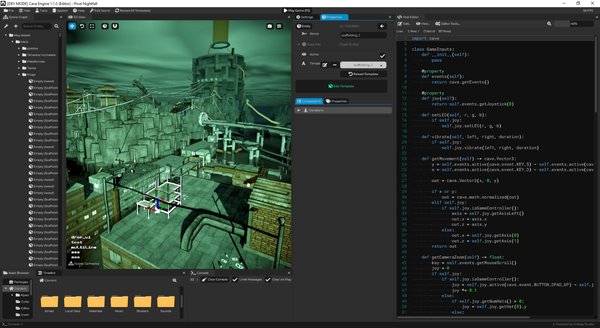
Cave Engine is a modern 3D game engine designed specifically for desktop game development using Python scripting with a C++ backend. The engine was built to simplify game creation while keeping professional capabilities.
The engine architecture follows a simple idea:
"A game dev tool is like a joke. If you need to explain it, it's not that good."
Instead of exposing every internal system, the engine focuses on clarity and speed of development.
Python Gameplay with a C++ Core
Cave is written entirely in C++ for performance. Every heavy system such as rendering, physics, animation, and scene management, runs in compiled native code.
Python acts as the scripting layer that orchestrates these systems.
Example Python component:
import cave

class MyComponent(cave.Component):

    def start(self, scene: cave.Scene):
        pass

    def update(self):
        events = cave.getEvents()

    def end(self, scene: cave.Scene):
        pass
In this architecture Python calls optimized engine systems instead of performing heavy processing itself. The result is a workflow that feels extremely fast during development while maintaining strong runtime performance.
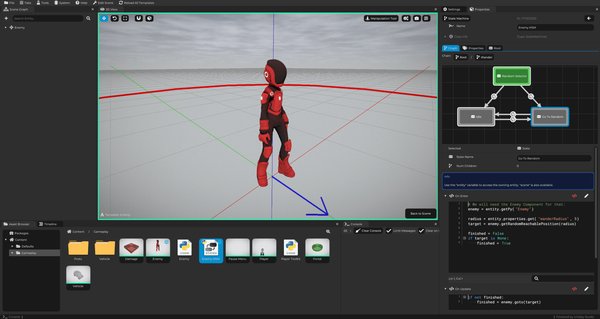
It's also possible to write Python directly into the multiple editors that the engine have, such as the State Machines, animation callbacks, UI Elements, etc:
Key Features That Make Cave a Strong Python Engine
Cave Engine includes a full production toolset instead of a minimal framework.
Entity Component Architecture
The engine uses a modern entity-component system.
Each entity is composed of components such as:
- Transform
- Mesh
- Physics
- UI
- Python logic
This modular design keeps projects organized and scalable.
Entity Templates
Reusable gameplay objects are created through Entity Templates, similar to prefabs.
You can create a structure once and reuse it across multiple scenes while keeping instance-specific overrides.
This makes it easy to build enemies, props, or gameplay systems.
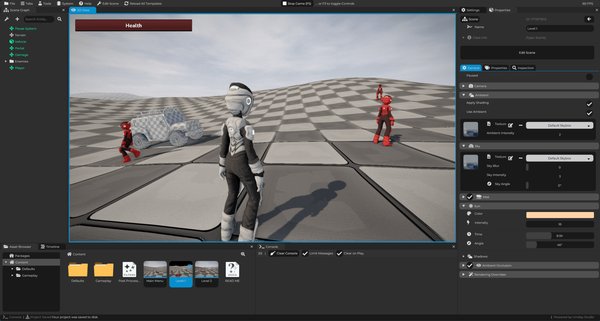
Integrated Editor
Cave provides a full editor environment where you can:
- create scenes
- import assets
- design levels
- edit UI
- script gameplay
- run your game instantly
The editor avoids heavy compilation pipelines. Developers typically experience almost zero loading screens while working.
Modern Rendering Pipeline
Cave includes a physically based rendering pipeline with features expected from modern engines.
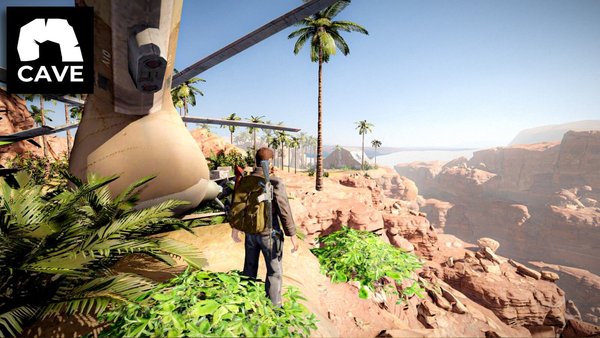
Rendering features include:
- PBR materials
- cascade shadow maps
- frustum culling
- mesh instancing
- depth pre-pass optimizations
- customizable shaders
- post-processing pipelines
These systems allow developers to build visually impressive 3D games without configuring multiple rendering pipelines.
Bullet Physics Integration
Physics simulation uses Bullet Physics, one of the most respected open-source physics engines.
This enables:
- rigid body physics
- character controllers
- vehicle simulation
- constraints and ragdolls
Because physics runs entirely in C++, gameplay scripts remain lightweight.
Animation System with Layering
Cave provides an advanced animation system capable of:
- multiple animation layers
- blending and speed control
- bone filtering
- root motion extraction
- animation callbacks
This allows complex animation behavior such as upper-body actions layered on top of locomotion.
Built-in AI with Hierarchical State Machines
For game AI, Cave includes a hierarchical state machine (HSM) system.
Developers can create AI logic visually while still writing behavior in Python.
Typical AI structures include:
- idle
- patrol
- chase
- attack
- flee
Each state can contain nested states, creating flexible behavior trees without complicated graph systems.
Why Cave Engine Is Ideal for Indie Developers
Most indie teams want two things from a game engine:
- fast development
- low technical friction
Cave was designed around these priorities.
Extremely Fast Workflow
Many engines require:
- shader compilation
- script compilation
- asset cooking
- pipeline configuration
Cave hides most of this complexity. Developers spend more time building gameplay instead of waiting for tools.
Lightweight Engine
The engine itself is extremely lightweight compared to large AAA engines.
Exported games can be as small as 10–20 MB, making distribution easier and improving startup times.
No Royalty Fees
Many engines charge royalties once your game generates revenue.
Cave uses a simple license model. Once you own the engine you can release commercial games without paying royalties.
Python vs Other Game Engine Languages
Most mainstream engines use different scripting languages.
| Engine | Primary Language |
|---|---|
| Unity | C# |
| Unreal | C++ / Blueprint |
| Godot | GDScript |
| Cave | Python |
Python offers several advantages:
- extremely readable syntax
- massive developer ecosystem
- strong AI and tooling integration
- fast prototyping
Because Python is widely used outside game development, many programmers can learn it quickly.
Who Should Use a Python Game Engine in 2026?
Python game engines work best for developers who value speed of development and simplicity.
They are especially useful for:
- indie developers
- solo game creators
- small studios
- educational environments
- rapid prototyping teams
For many teams, writing gameplay logic in Python dramatically reduces development time compared to C++ or complex visual scripting systems.
Final Thoughts
The demand for Python game engines continues to grow. Developers want the simplicity of Python combined with the power of modern 3D tools.
In 2026, Cave Engine stands out as one of the most practical solutions for this approach. It combines:
- Python scripting
- C++ performance
- a full 3D production pipeline
- extremely fast iteration
For indie developers who want to build real 3D games without the complexity of large AAA engines, it offers a compelling alternative.
FAQ
What is the best Python game engine for 3D games?
Cave Engine is currently one of the most complete Python-scriptable engines designed specifically for 3D desktop game development.
Can Python run fast enough for 3D games?
Yes. Modern engines use Python only for gameplay logic while heavy systems run in compiled languages such as C++.
Is Python good for indie game development?
Yes. Python allows faster iteration and simpler code compared to many traditional game development languages.
Does Cave Engine support commercial games?
Yes. Games created with Cave can be released commercially without royalties.
Is Python easier than C++ for game scripting?
Yes. Python syntax is simpler and easier to learn, making it ideal for gameplay scripting.